When and How to Harvest Basil for Bushier Plants
Basil is generous, but only on its own terms. Leave it alone and it will shoot up as a single stem, throw out a flower spike and call it a season. Pinch it correctly and the same plant branches into a dense, leafy bush that keeps producing until the first cold nights. The difference between those two plants is about ten seconds of work, repeated every fortnight or so.
When basil is ready to pick
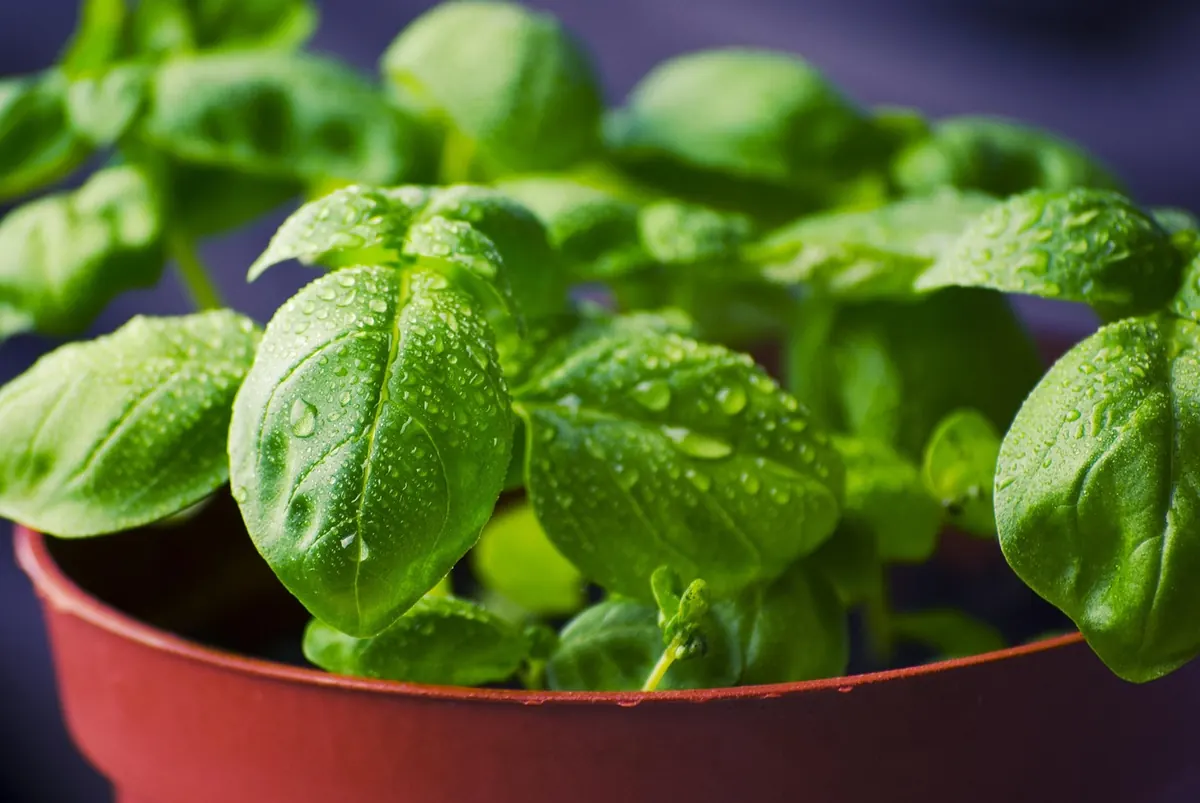
A young plant with only its first pair of seed leaves has nothing to spare. Wait until it has at least two or three pairs of true leaves — six to eight leaves in total — before you take anything. A plant that size can lose its growing tip and bounce back within a week.
Time your picking for the morning, once the dew has dried but before the sun gets strong. That is when the aromatic oils in the leaves are at their most concentrated. Early evening, after the heat has gone out of the day, is the next best window. Midday harvesting in a hot greenhouse rarely ends well: the leaves wilt within minutes and the flavour seems thinner.
Two situations call for patience. Never harvest from a plant that is wilting or bone dry — water it, wait a day, then pick. And if you have just brought home a supermarket pot of basil, give it a week to settle into its new spot before you start cutting.
Pinching basil: the technique that doubles your plant
Every basil stem is built in pairs. Leaves sit opposite each other, and in the angle where each leaf joins the stem — the node — there is a tiny dormant bud. At the very top sits the growing tip, a small cluster of new leaves. That tip produces a hormone that keeps the buds below it asleep.
Remove the tip and the two buds nearest the cut wake up and start growing. One stem becomes two. Do it again a fortnight later and two become four. This is why a pinched plant stays compact while an untouched one stretches towards the light.
The pinch, step by step
- Find the top pair of leaves on a stem, with the little cluster of new leaves sitting in the middle.
- Move down the stem to the pair of leaves directly below that cluster.
- Pinch the stem just above that pair, leaving about 3–5mm of stem above the leaves. Fingernails are fine; sharp scissors or snips are easier once stems thicken.
- Keep the tip you removed. It is tender and completely edible.
- Work around the plant rather than stripping one stem, so it stays balanced and upright.
The cut should always sit just above a pair of leaves. Cutting a stem back to a bare stretch leaves a stub that dries out and can rot, and cutting below the lowest leaves on a young plant can stop it in its tracks.
One habit worth breaking: pulling individual leaves off a stem. You get a leaf, but no new growth point, and the plant grows steadily more bare. Pinch the stem, take the tip, eat the leaves.
Flower buds: pinch them out early
Basil's whole ambition is to flower, set seed and finish. The warning sign appears at the top of a stem — a tight, pale cluster of buds, often ringed by a few small leaves. Pinch it out the moment you spot it, cutting back to the next leaf pair down.
Once those flowers open, the plant shifts its energy into seed production, and the leaves turn smaller, tougher and noticeably more peppery. That is fine for some Thai dishes, less welcome in a salad of tomatoes and mozzarella.
If a plant gets away from you and flowers fully, don't write it off. Cut it back by about a third, to a leaf pair, water it well and give it a liquid feed. It will usually push out fresh growth within a couple of weeks, though growth slows as the season runs down. If you have a spare plant, let that one flower — bees and hoverflies love basil flowers, and the seed often self-sows in a greenhouse bed.
How much to take, and from where
The one-third rule is a good guide: never remove more than a third of a plant's leaf area in one go. Leaves are the plant's engine, and a stripped plant has nothing left to power regrowth from.
From a small plant, take one or two tips a week — enough for a salad. From a mature plant in midsummer, you can cut whole stems back to a leaf pair lower down and come away with a decent handful for pesto without doing damage. Regular small pickings beat one big harvest: a fortnightly pinch keeps the plant in a cycle of fresh growth and gives you a steady supply instead of a glut followed by a bare pot.
Different basils, slightly different rules
- Large-leaved Italians such as Genovese: pinch early and often, as they bolt fast in heat.
- Bush and Greek basils: naturally dense with small leaves, so they mainly need the flower buds removing.
- Thai basil: stronger stems and slower to bolt, which makes it ideal for repeated cutting.
- Purple basils: slower growers, so take less from them at a time.
Common harvesting mistakes
- Cutting in the middle of a leaf gap instead of just above a leaf pair.
- Harvesting from the bottom of the plant, where the leaves are oldest and toughest. The best flavour is in the top third.
- Picking during the heat of the day.
- Leaving flower buds in place because they look attractive.
- Cutting back hard on a young, dry or recently moved plant.
- Using blunt scissors that crush the stem instead of slicing it.
Keeping the harvest coming
Water at the base in the morning, and once you are cropping regularly, feed every two to three weeks with a balanced liquid feed. Keep pinching, and sow a fresh pot every three to four weeks from late spring into midsummer. Older plants slow down, and a succession means you never depend on one tired stem.
Before the first cold nights, pot up a plant or take cuttings to bring indoors onto a bright windowsill. Kept pinched and watered sparingly, it will carry on through winter, giving you a few leaves at a time until it is warm enough to sow again.
Photo: ulleo / Pixabay